
Edumetrics: Measuring Human Capital for the 21st Century
09 février 2026
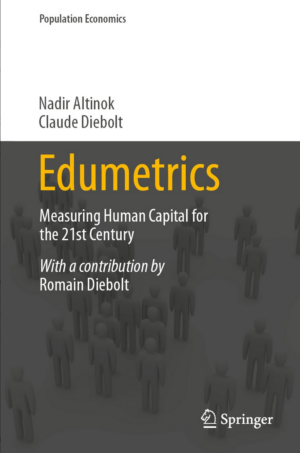
Nadir Altinok et Claude Diebolt, “Edumetrics: Measuring Human Capital for the 21st Century”, Springer Nature, coll. Populations Economics, 2026, IX, 318 pages.
Cet ouvrage :
- présente les tendances mondiales en matière d’éducation à l’aide du plus grand ensemble de données sur les résultats d’apprentissage depuis 1970 ;
- révèle les coûts cachés de l’inégalité en matière d’éducation grâce à des données rigoureuses et à une analyse contrefactuelle ;
- mesure non seulement l’accès à la scolarité, mais aussi les acquis réels dans plus de 120 pays.
Présentation éditeur : This book introduces edumetrics, a rigorous, interdisciplinary framework for measuring learning outcomes over time and across space. Based on Lord Kelvin’s maxim that “to measure is to know,” edumetrics redefines education as an empirical science that integrates economics, psychology, and social science to quantify cognitive and non-cognitive competencies.
By harmonizing data from over 120 countries spanning half a century, the book transforms fragmented indicators into coherent measures of learning quality and equity. It critiques the limitations of traditional human capital theory and challenges the use of years of schooling as a proxy for skill. Through econometric analysis, historical inquiry, and global datasets, including Learning-Adjusted Years of Schooling, it reveals that educational structures, not just resources, shape productivity, adaptability, and social cohesion.
At its core, the book addresses the paradox of why rising investments in schooling have not yielded proportional gains in learning. With its integration of theory, data, and historical perspective, it serves as both a methodological blueprint and a call to rethink how we define, measure, and value learning in the twenty-first century.